
The current valuation is 38 per cent higher than the 10-year average of 22x and over 50 per cent higher than the 20-year average of around 20x.

While the crackdown is a major step in combating tax evasion and improving transparency, it might also impact the flexibility and genuine corporate structures created to achieve legitimate objectives, says Suresh Surana.

Any saving on the car loan EMI can translate into major savings.
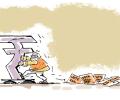
'Since the growth is not fast enough to provide jobs for the young, the fallout will be political and social,' warns T N Ninan.

'The effect will be seen two-three quarters down the line.'

A chunk of divestment till now has come from follow-on offerings in the Centre's two ETFs, Bharat-22 and CPSE. Now, there will be initial public offerings of Mazagon Docks, rail companies RVNL and IRFC and MSTC.

Sensex rose 5.8% this year, against a 3.2% rise in Nifty; Axis Bank inclusion may blunt Sensex edge

The Aditya Birla Group announced the merger of its two holding companies, Aditya Birla Nuvo and Grasim, to make the holding structure clearer, ensure stable cash flows and unlock value in its financial services arm

10 non-bank and non-finance stocks from the BSE500 Index universe that offer an optimal blend of low valuation, reasonably robust revenue and earnings growth in recent quarters, a strong balance sheet, and most importantly, positive cash flow from their operations.

The rupee breached the 80-mark against the dollar on Tuesday. The steady depreciation in the value of the rupee against the US dollar is likely to prove expensive for corporate India. The listed companies' revenue expenses in foreign currency or imports exceed their export revenues or revenue earnings in forex. In their latest financial year, BSE500 companies, excluding banks and non-banking finance companies and insurance (BFSI), reported combined forex expenses of Rs 12.31 trillion against forex earnings of around Rs 10 trillion.

Economists praise Das for his pragmatism and willingness to face challenges head on. And in doing so with the finesse of an able administrator.

Experts say foreign investor sentiment was bolstered by the US Federal Reserve's decision to go slow with interest rate hikes and hopes of political stability.

The recent default on deposit payments by a couple of Yash Birla Group companies has brought to surface difficulties an investor has to face in recovering his money.

According to the report, financial assets of the Indian households are predominantly in the form of bank deposits, followed by life insurance - a pattern that got disrupted after note ban

Among the stocks that have seen the largest cut by MFs, the DVR shares (shares with differential voting rights) of Tata Motors have seen a cut of 243 basis points (bps) in MFs' stake.
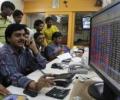
Markets ended lower for the third straight day on Tuesday weighed down by profit taking in rate sensitives with bank shares leading the decline after hopes of rate cut by the central bank faded.

What ex-IL&FS top brass got for loans? Foreign trips, private jets and chopper rides.

Tata Sons, holding company for the Tata group, is working on building a centralised rural business platform that could be leveraged for the entire group's benefit, instead of each company looking at it separately.

As a result of this moratorium, individuals' EMI payments of loans taken will not be deducted from their bank accounts, providing much needed liquidity to borrowers whose income has been disrupted due to the lockdown till May 31.

"We see the Indian economy rebounding from our projected 6.1 per cent growth this fiscal year to something like 7 per cent in the next fiscal year (2020). We see the factors that will support growth, including monetary policy stimulus, working their way through the pipeline," Jonathan Ostry, Deputy Director, Asia Pacific Department at the IMF, told reporters.

With a loan book of $268 billion, India's retail banking is now ahead of Russia, Malaysia and Mexico but behind China, Brazil and Thailand

Pulbic banks have no reason to cheer Budget announcement.

The NDA government will be following the footsteps of its predecessor, the UPA, which had introduced the concept of "loan mela" to boost credit by directing banks to lend to people through public meetings.

PSB chiefs tried to argue that liquidity is in surplus in the system and the problem was related to lack of demand in the economy, instead of banks' reluctance to lend, but 'the FM said it is a perception issue that loan is not available, which we need to dispel,', reports Somesh Jha.
Fintechs need to behave with responsibility and transparency. A lot of mis-selling has been happening. Other issues have been plaguing the fledgling industry -- high interest rates, even higher processing fees, harsh collection process and, most critically, data leakage leading to rampant frauds, points out Tamal Bandyopadhyay.

Investors in LIC's insurance and other schemes are receiving a lower rate of return because LIC is subsidising incompetence at best and malfeasance at worst in institutions such as IDBI Bank and IL&FS, says Jaimini Bhagwati.

In 2018, venture debt providers cumulatively deployed Rs 1,300 crore. This year, the market is expected to absorb venture debt of Rs 1,800 crore to Rs 2,000 crore. So what makes this asset class so attractive?

Payments banks are niche banks set up by the Reserve Bank of India to further the agenda of financial inclusion.
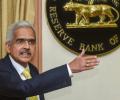
'His (Das) approach to work seems that of working as a team with ease in communication.'

IMF believes it is mostly cyclical, not structural, but because of the financial sector issues, recovery will be not be quick. IMF said, it saw an opportunity with the strong mandate of the new government to reinvigorate the reform agenda to boost inclusive and sustainable growth.

According to the RBI's Financial Stability Report, the industry's gross bad-loan is at a 14-year high. As RBI's March 2017 deadline for banks to clean up soured credit looms closer, Shailajanand Mishra takes stock of just how bad the situation is.
Readying itself for a bank licence, Anil Ambani-led group's Reliance Capital on Wednesday said Japan's Sumitomo Mitsui Bank and Nippon Life would become its strategic partners in the proposed banking venture, with each having 4-5 per cent stake.

Ahead of India's annual budget presentation next week, IMF's chief economist Gita Gopinath has favoured the extension of the pandemic support measures, thrust on investment in infrastructure and expanding health sectors programmes like Ayushman Bharat, and a very credible divestment path for commercially viable companies. The Indian government has provided a lot of schemes for small and medium enterprises, most of which is in the form of liquidity support, Gopinath told PTI on Tuesday. "And you want to revisit it and see how effectively that is working and see whether additional support may need to be provided," she said while responding to a question on her recommendations to Finance Minister Nirmala Sitharaman, ahead of her presentation of the annual Union Budget on February 1. It would be a good time for banks and Non-Banking Financial Companies (NBFCs) to raise capital given the attractiveness of financing conditions at this point, she said.

'If through growth and serving the customer we become number one, we will be very happy and very proud.'

Given the various risks to growth, one could argue for rate cuts to be deeper than the 5 per cent terminal repo rate that we are projecting at this stage, says Kaushik Das.

A plea that the banking regulator's stress should be on the strategic role of boards and an increase in the remuneration of independent directors were among the issues put forward to the Reserve Bank of India's (RBI's) top brass in its interaction with the full boards of state-run banks held on Monday. The meeting, the first leg of first-of-its-kind interactions with the boards of state-run banks, will now be followed by those of private banks in Mumbai on May 29. The RBI's press release, issued late on Monday, did not refer to the specific points that found mention in the deliberations, but top sources told Business Standard the twin concerns were taken up in the open-house interaction with the banking regulator's brass.

The Kunal Bahl-led firm wants to add 1,000 sellers every three months in its loan scheme.
In the same quarter a year before, most of them had reported a dismal performance.

The global turmoil in the banking sector has made analysts cautious, who advise that investors stay away from stocks of this sector till the overall sentiment improves. The recent trouble for the banking sector started with the collapse of US-based Silicon Valley Bank (SVB), Silvergate Capital and Signature Bank. On its part, Moody's Investors Service has also cut its outlook for the US banking system to 'negative' from 'stable', citing the run on deposits at these three banks that led to the collapse of these banking majors in less than a week.

"The shift is gradually happening more on account of favourable risk-reward for stocks in these sectors and the shift would be more pronounced as investors roll over their targets to 2017," the head of research at a foreign brokerage said.
